
Scope of the Policy
This stand-alone policy sits alongside the College’s Safeguarding Policy and is designed to cover the specific details of how the College manages child on child abuse, sexual harassment/abuse and online sexual/harassment/abuse complaints by its students.
This strengthening of College policy is in response to the findings by Ofsted in June 2021 in its paper ‘Review of Sexual Abuse in Schools and Colleges’ published 10 June 2021.
This Policy now forms part of the College’s safeguarding framework and relevant training is provided to all staff.
The remainder of this document below sets out the key components of provision and the actions that will be taken annually to ensure that all children and vulnerable adults are adequately protected, supported and educated in regard to sexual abuse and online sexual abuse.
Key Aims:
This is a zero-tolerance policy. There is to be no acceptable reason for sexual harassment/abuse and online sexual/harassment/abuse
Systems in College (Smoothwall) are operable to detect any online sexual abuse from students, staff or any outside agency.
To ensure there is a clear system in place for reporting of sexual harassment/abuse and online sexual/harassment/abuse in College.
To ensure that the BSafe team responds to swiftly and effectively if sexual harassment/abuse and online sexual/harassment/abuse is reported in College.
To provide annual training/update training to all College staff as part of our safeguarding update training.
To ensure all learners and their parents are aware of this policy and the likely action the College will take should any student be a perpetrator of sexual harassment/abuse and online sexual/harassment/abuse
To ensure that all learners and their parents are aware of what constitutes sexual harassment/abuse and online sexual/harassment/abuse
To ensure that the pastoral programme educates the learners around sexual harassment/abuse and online sexual/harassment/abuse, including online and to revisit this frequently.
To build a culture of mutual respect which has no place for sexual harassment/abuse and online sexual/harassment/abuse.
To hold annual focus groups with learners to elicit the current climate in the College and how well the measures taken by the College to protect learners from child-on-child abuse sexual harassment/abuse and online sexual/harassment/abuse are working at each touch point.
To support our parents/guardians by providing clear and useful information on this important topic.
What constitutes child on child sexual harassment/abuse and online sexual/harassment/abuse?
Sexual violence, such as rape, assault by penetration and sexual assault.
Sexual harassment/abuse, such as sexual comments, remarks, jokes and online sexual harassment, which may be stand alone or part of a broader pattern of abuse.
Upskirting, which typically involves taking a picture under a person’s clothes without them knowing with the intention of viewing their genitals or buttocks to obtain sexual gratification, or to cause the victim distress or alarm.
Sexting (also known as youth produced sexual imagery.)
Online Activity of this nature may include:
Receiving unsolicited explicit photographs or videos (cyberflashing)
Sending or being pressured to send nude and semi-nude photographs or videos
Being sent or shown unsolicited explicit material, such as pornographic videos
Harmful sexual behaviours are deemed to be those behaviours that are developmentally inappropriate for their age range. The Figure 1 below gives examples of what is ‘normal’ sexual behaviour for an age range and those behaviours that are not normal and as such would be dealt with by the College in accordance with this policy and in tandem with the College’s code of Conduct and Disciplinary Policy.
Figure 1. Definition: Sexual behaviours across a continuum
Normal | Inappropriate | Problematic | Abusive | Violent |
Developmentally expected
Socially acceptable
| Single instances of inappropriate sexual behaviour
| Problematic and concerning behaviour
May lack reciprocity or equal power May include levels of compulsivity | Victimising intent or outcome
| Physically vioent sexual abuse
|
Source: Hackett, S, ‘Children, young people and sexual violence’ in ‘Children behaving badly? Exploring child violence between children and young people’, 2010. | ||||
Whilst all young people can experience sexual harassment and violence, research indicates that girls are disproportionately affected. In 2021 girls aged 15 and 17 reported the highest annual rates of sexual abuse for young people and children aged 25 and under.
This known information will shape our delivery plans, workshops, focus groups and support.
Responding to allegations/incidents of child-on-child abuse sexual harassment/abuse and online sexual/harassment/abuse
Where child on child sexual harassment/abuse and online sexual/harassment/abuse is detected or reported in College the following steps will take place:
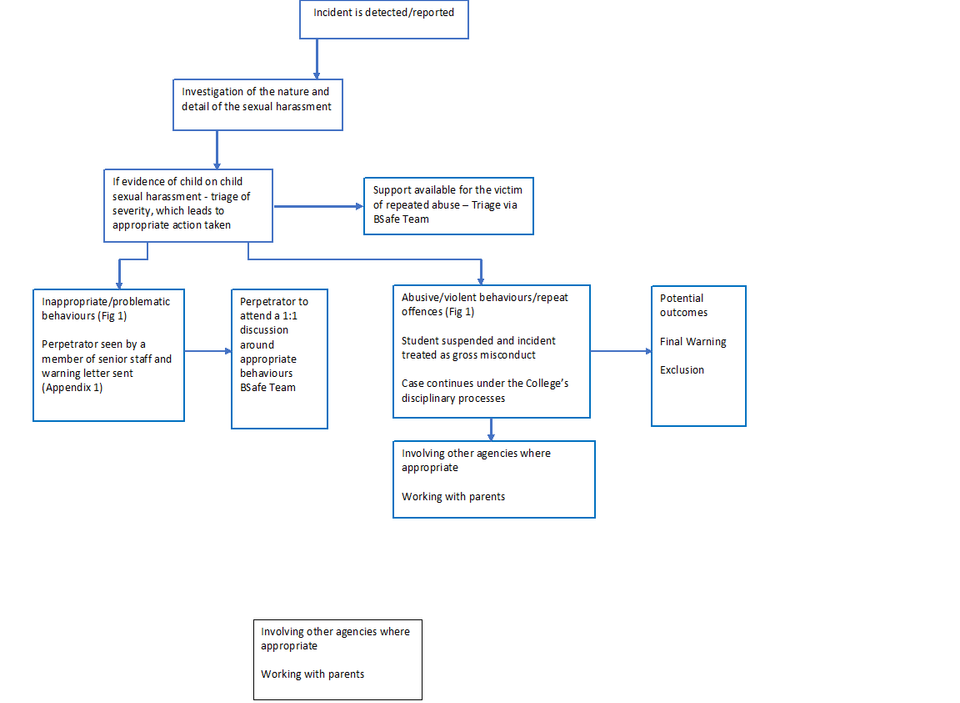
Other Activity
In order to support the expected College culture of mutual respect, a number of activities will be delivered throughout an academic year. These will include:
Annual update training for staff
Visual reminders to students on posters and on College screens
Coverage of the topic and expectations for behaviour in tutorial sessions as part of a full programme of activities
Regular focus groups held
Information on how to report any child-on-child sexual harassment/abuse and online sexual/harassment/abuse
Workshop sessions
Information for parents via the Parent Portal
Reporting
Students – students can report any form of child-on-child sexual harassment/abuse and online sexual/harassment/abuse or other abuse by:
telling a member of staff
approaching a member of the BSafe Team
pressing the Stop Alert button
Staff – staff should deal with any inappropriate behaviour in their classrooms or social spaces in the College as they occur
They should report any incidents to the AP Pastoral/DSL/Member of the BSafe Team.
In the event of any of the above occurrences the AP pastoral will initiate the investigation process.
This policy should be read in conjunction with:
The Sixth Form Bolton`s Safeguarding Policy
IT Acceptable User Policy
Student Code of Conduct
Appendix 1 Example letter
Dear
I am writing to you to highlight a recent concern relating to some behaviours that XX was displaying within the College on XXXXX. At The Sixth Form Bolton, in response to the Department for Education advice and principles set out in the statutory guidance “Keeping Children Safe in Education”, we have adopted a whole centre unacceptable behaviour approach. This includes sanctions, when appropriate, to reinforce a culture where child on child abuse, sexual harassment and online sexual abuse is not tolerated within the College either on site or online.
On the day in question XXX was displaying behaviours that we would consider inappropriate under the child-on-child abuse categories and as such are not tolerated within the College. XX has been spoken to and challenged for their actions. We hope that together with our ongoing support, education and delivery within tutorials XXX can address their behaviours to ensure they use appropriate and acceptable behaviours when interacting with children/peers in the future.
The Sixth Form Bolton is dedicated to eradicating Child on Child abuse, sexual harassment/abuse be it online or face to face and educating our staff and students in healthier relationship behaviours. We are determined to create an environment in which our students and staff show complete respect for one another. They should know what language and behaviours are acceptable and what to do and who to speak to if they are worried or feel unsafe.
Thank you for your support in this matter,
Sarah Ball
Assistant Principal
Appendix 2
Glossary of terms
Smoothwall - (formally Esafe – provides online monitoring of our digital learning environment including use of the internet in order to safeguard our students)
Harmful sexual behaviours – sexual behaviours expressed by children and young people under the age of 18 years old that are developmentally inappropriate, may be harmful towards self or others or abusive towards another child, young person or adult (DfE). Please note for The Sixth Form Bolton, this includes all young people under the age of 19 years old.
Sexual violence, such as rape, assault by penetration and sexual assault.
Sexual harassment, such as sexual comments, remarks, jokes and online sexual harassment, which may be stand alone or part of a broader pattern of abuse.
Upskirting, which typically involves taking a picture under a person’s clothes without them knowing with the intention of viewing their genitals or buttocks to obtain sexual gratification, or to cause the victim distress or alarm.
Sexting (also known as youth produced sexual imagery.)
This site uses cookies that enable us to make improvements, provide relevant content, and for analytics purposes. For more details, see our Cookie Policy. By clicking Accept, you consent to our use of cookies.