

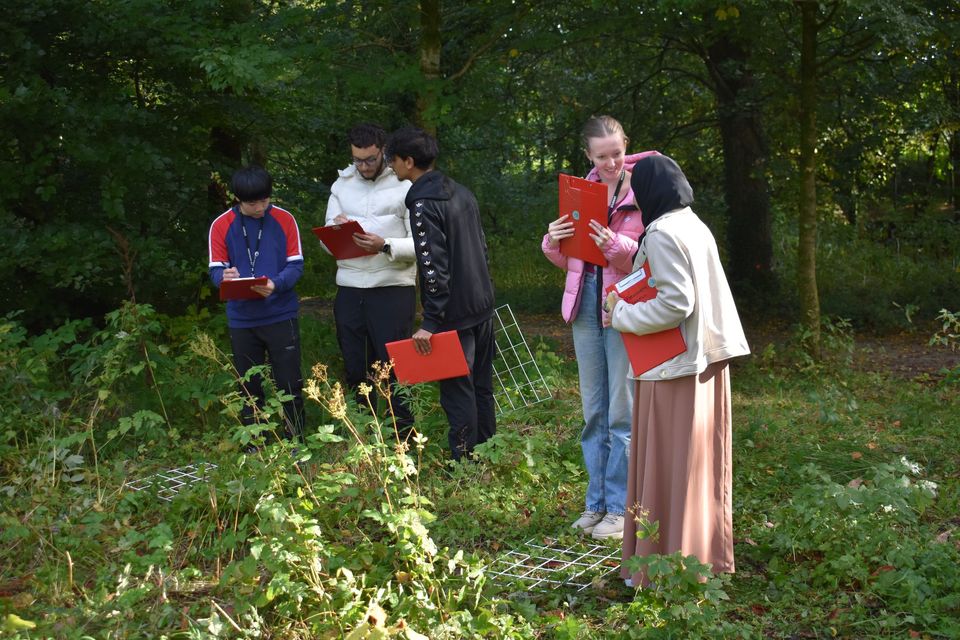
At The Sixth Form Bolton, sustainability is a core strategic priority. We are committed to protecting natural resources, reducing waste, and creating systems that are environmentally responsible, economically viable, and socially equitable. Our approach to sustainability is rooted in long-term thinking and meaningful action that benefits both current and future generations.
Sustainability also plays a vital role in empowering young people to understand the relationship between the environment and the world around them. In April 2022, the Department for Education published its Sustainability and Climate Change Strategy, aligning with UK legislation to achieve net zero by 2050. Reflecting our ambition and leadership ethos, The Sixth Form Bolton has set a target to achieve net zero emissions by 2040, ten years ahead of national targets.
Our environmental journey to date
The Sixth Form Bolton established a Sustainability Working Group that meets regularly and works closely with the Senior Leadership Team to drive progress. The College is currently working with a Sustainability Consultant to support the development of a further ambitious and robust strategy. To strengthen delivery, an internal Sustainability Lead is being recruited to coordinate actions and ensure long-term impact.
Actions taken to reduce our carbon footprint
Installation of LED lighting throughout the building, reducing energy usage by 57%
Installation of roof insulation exceeding thermal performance targets
Installation of solar panels across the College roof
Introduction of recycling facilities across main College areas, including food and liquid waste streams
Installation of more efficient ventilation systems
Trade-in of old IT equipment in exchange for carbon credits
Extension of equipment lifecycles beyond the standard 3–5 years
Fruit trees being planted - pollinators
Investment in indoor plants to improve wellbeing and air quality
Building Management System (BMS) improvements to monitor electrical usage
Air Con turned off by default during Spring and Summer months (April to October)
Introduction of a ‘Switch Off’ energy reduction campaign
Transition to fully electronic communications, significantly reducing postage
Provision of reusable water bottles and installation of additional water fountains
Sale of only cans and rPET bottled water in vending machines
Reduction of marketing print
Introduction of sustainable cleaning products
Implementation of Approved Supplier Criteria aligned with the Sustainability Strategy
Key staff are trained as Carbon Literacy Champions and can deliver Carbon Literacy Training
Delivery of Carbon Literacy training for all staff
Student leadership and engagement
Sustainability is embedded within the Learner Voice through a dedicated Sustainability Group and a nominated Student Sustainability Lead. Student-led initiatives include community litter-picking, development of recycling guidance videos, research into the environmental impact of AI, active travel promotions, pre-loved clothes rail, and collaboration with catering teams to introduce more sustainable and plant-based food options. Sustainability Reward Coins recognise and encourage positive environmental behaviours among students.
Student-led projects in 2025
Green Skills Club (Enrichment)
Community Clean-Up (Enrichment)
Eco Factory Experience (STEM)
Oxford Saïd Global Climate Change Challenge (STEM)
Sustainability Pathway designed by SUEZ Waste Management (PGP)
Future commitments
Appointment of a Sustainability Lead to steer strategic delivery
Delivery of Carbon Literacy training for all students
Commitment to the Race to Zero campaign
Expansion of recycling facilities across all College areas
Insect/Bug Hotels in limited outdoor space
Investigate an Air Source heat pump to replace aging gas boilers
Purchase of energy from renewable sources
Further reduction in printing across the College
Carbon reporting - we are making substantial progress at reducing our tCO2e (tonnes CO2 equivalent)
Scope 1 (Gas) | Scope 2 (Elec) | Scope 1 & 2 Totals | |
2021 | 61.37 tCO₂e | 145.25 tCO₂e | 206.61 tCO₂e |
2022 | 43.98 tCO₂e | 147.82 tCO₂e | 191.80 tCO₂e |
2023 | 48.95 tCO₂e | 148.91 tCO₂e | 197.86 tCO₂e |
2024 | 44.09 tCO₂e | 122.17 tCO₂e | 166.26 tCO₂e |
2025 | 32.80 tCO₂e | 100.08 tCO₂e | 132.88 tCO₂e |
Performance Overview and Trends
Scope 1 (Gas)
Scope 1 emissions reduced from 61.37 tCO₂e in 2021 to 32.80 tCO₂e in 2025
This represents a 46.6% reduction over the five‑year period
Reductions are consistent with:
Improved heating controls and efficiency
Reduced gas demand
Behavioural and operational changes
Scope 2 (Electricity)
Scope 2 emissions reduced from 145.25 tCO₂e in 2021 to 100.08 tCO₂e in 2025
This represents a 31.1% reduction
The most significant reduction occurred between 2023 and 2025, aligned with:
Lower electricity consumption
Ongoing grid decarbonisation
Potential efficiency improvements in lighting and IT equipment
Combined Scope 1 & 2 Emissions
Total operational emissions fell from 206.61 tCO₂e in 2021 to 132.88 tCO₂e in 2025
This represents an overall reduction of 73.73 tCO₂e, equivalent to a 35.7% decrease
The trend demonstrates sustained progress in reducing the College’s core operational carbon footprint
This site uses cookies that enable us to make improvements, provide relevant content, and for analytics purposes. For more details, see our Cookie Policy. By clicking Accept, you consent to our use of cookies.